
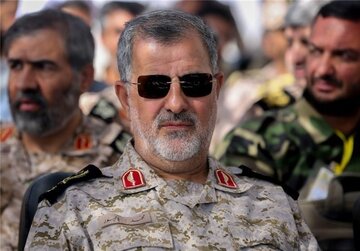
According to Khabaronline, an Iranian news agency, speaking at an academic event in Tehran on Monday, Major General Mohammad Pakpour, Commander-in-Chief of the Islamic Revolutionary Guard Corps (IRGC), said the enemy’s initial strategy was to combine airstrikes, intelligence operations, and domestic unrest to trigger a collapse in Iran’s security architecture.
He said the “hybrid war” plan envisioned the assassination of senior commanders, coordinated incursions by armed groups across Iran’s borders, and simultaneous efforts by domestic networks to incite internal chaos. According to Pakpour, this calculation “failed completely” as public unity and swift reorganization of command filled the gaps created in the early hours of the conflict.
A significant portion of his remarks focused on Iran’s missile response. Pakpour said Israel assumed Iran would be unable to fire more than “a limited number of missiles,” believing the command structure had been disrupted. Instead, he said, Iran launched “multiple waves of drones and missiles” beginning on the first evening of the conflict, with the scale and precision of the strikes increasing in the following days.
Pakpour highlighted the attack on the U.S. Al-Udeid Air Base in Qatar as a turning point. He stated that the base—one of Washington’s most important military installations in the region—was hit with 14 Iranian missiles. According to him, several countries attempted to mediate and dissuade Iran from carrying out the strike, but Tehran insisted it would “respond to every bomb dropped on Iran.” He added that after the attack, the United States conveyed that “if Iran stops, we will also stop.”
The IRGC commander cited four factors behind Iran’s success: “divine support,” “centralized leadership,” “public unity,” and “continuous missile retaliation.” He said Iran never left any enemy strike unanswered and claimed that growing public pressure inside Israel due to Iranian missile attacks ultimately pushed Israeli authorities to seek a ceasefire.
Pakpour also emphasized the decisive role of advanced technologies in the conflict, describing it as a “war of technology.” Artificial intelligence, he said, played a critical role for both sides in intelligence gathering, surveillance, and targeting. He stressed the need for Iran to enhance its military capabilities—particularly in air defense and stealth technology—arguing that equipping Iranian missiles with stealth features would “significantly increase their ability to penetrate Israeli defense systems.”
He added that although the situation is now one of “cessation of hostilities,” Iran’s adversaries understand that any future action against the Islamic Republic would be met with a “more severe and more forceful response” than before.
Your Comment