

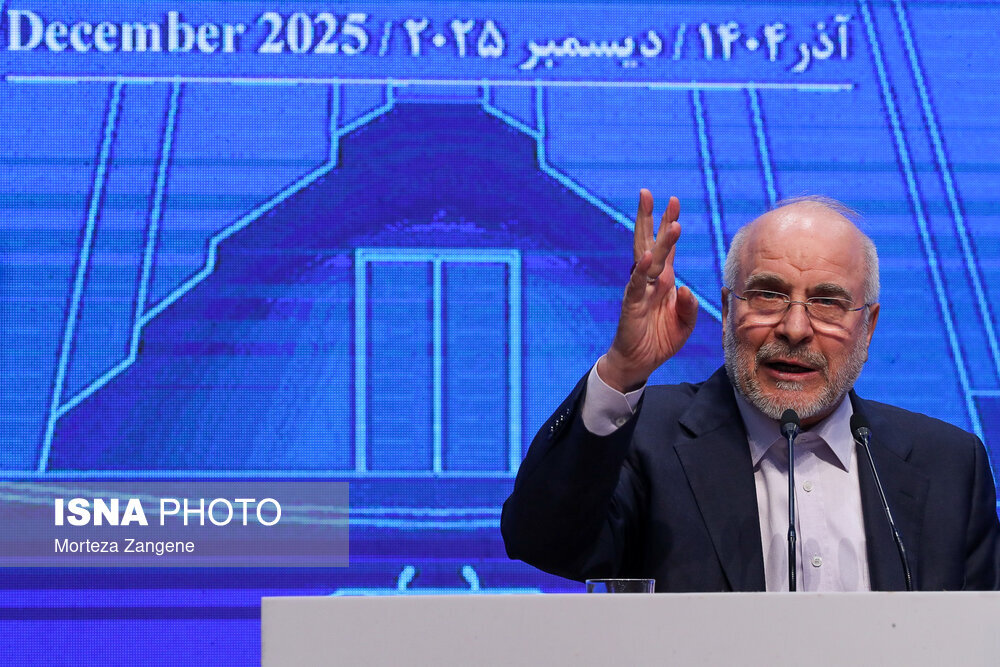
According to Khabaronline, an Iranian news agency, On Tuesday, Mohammad Bagher Qalibaf, the Speaker of Iran’s Parliament, answered questions from domestic and foreign reporters at the second press conference of the 12th Parliament Speaker.
At the beginning of the conference, he expressed gratitude for the unity of the Iranian people in the face of the recent Israeli aggression against Iran, stating: “Our enemy entered the 12-day war with a specific design.”

Surprised by the Enemy’s Tactics, Not by the War Itself
“I emphasized at that time as well that we were not surprised by the occurrence of war itself, but we were surprised by the type of design and the method of the enemy’s operation, which was a shameless terrorist aggression; an aggression designed by the criminal ruling body of the Zionist regime with the cooperation of the United States, he added.”
He said: “But with the wisdom, courage, and precise, intelligent decisions of the Supreme Leader in those very first moments and hours of the aggression, all our dear commanders—who later became martyrs—were also appointed, entered the field, briefed the commanders, and began the operation. Perhaps there were only a few hours of delay in starting the response, but we quickly stood against the enemy.”
The Speaker emphasized: “Within about five days, we achieved sufficient control over the air and land of the Zionist enemy, and conditions developed in such a way that from the sixth and seventh days, the enemy was seeking to stop the confrontation and reach a ceasefire at any cost.”
The Nation’s Unity as Iran’s True Source of Strength
Qalibaf added: “This achievement was the result of the wisdom and courage of the Commander-in-Chief, the sacrifice and resistance of our beloved nation—women and men, children and adults—and also the precise planning and operations of the armed forces that brought the enemy to its knees.”
He said: “Today, we fully believe that our power is not only in military and missile capabilities; our main strength, after God’s grace, is in the hearts of our people. A nation that sincerely stood in service of dear Iran, dear Islam, and their country’s dignity.”
He continued: “This victory, with such a level of cohesion, not only brought more beauty and glory for our nation, but also made Iran’s power more prominent in the eyes of the world.”
Iran–U.S. Relations
Mohammad Bagher Qalibaf, regarding the problems in Iran–U.S. relations, said: “The main root of the problem is America’s excessive demands; a country that neither intends real negotiations nor seeks a fair agreement, but rather wants to impose its own demands and force the other side into submission.”
Qalibaf stated: “In the 12-day war, we showed that we neither accept submission nor imposition. We were in the middle of negotiations, when on June 13 we were attacked and bombarded. We were supposed to continue the negotiations on June 15 in Oman, but they bombarded the negotiation table in fact.”
Qalibaf continued: “We are people of engagement and negotiation. Now that they have seen our power, they raise issues such as restricting missile capabilities and setting a 300-kilometer limit, while they themselves brazenly violate international laws and attack regional countries.”
He said: “If negotiations are to take place, they will only be within a real and equal framework. America’s recent behavior showed that not only do they lack honesty, but they also enter the negotiation process with conspiracy and lies.”
Will Iran Enter Another War?
He also addressed the question of whether a war between Iran, the United States, and Israel might break out, stating: “Through the operations of True Promise 1, 2, and especially True Promise 3, Iran has gained invaluable military experience—both in tactics and in technology."
Qalibaf stated: “Many times in the real battlefield, with that air dominance, over 100 missiles were fired in a limited time so that more than 70 percent would hit the target, and our accuracy increased every day.”
"Let me say this clearly: God willing, no war will occur. If reason prevails, they certainly learned from the previous conflict in which they were defeated and achieved none of their objectives, he said."
He clarified, "Today, I say that our quantitative and qualitative capabilities against any aggression by the enemy—whether the United States or the Zionist regime—will bring a stronger, more effective, and more precise response.”
Europe’s Current Global Role
Regarding Europe’s diminished global role and its impact on future negotiations with Iran, he said: “Europe has effectively removed itself from matters related to Iran and the nuclear issue and has no role left; it eliminated itself from the game under U.S. pressure."
"I state clearly: Europeans activated snapback under direct U.S. instruction, as if they had no independent will. On the other hand, Europe now has no role in issues related to Ukraine either, he added."
Will Iran Rebuild Its Bombed Nuclear Facilities?
The Speaker of Parliament said: “In the nuclear issue, the aggressors against Iran’s territory acted against all laws, the NPT, and the Agency, and they bombed our nuclear facilities. But what did the Agency do? Nothing. Meanwhile, they possess bombs and are under no oversight.”
Regarding the timeline for rebuilding Iran’s bombed nuclear sites, Qalibaf said: “The safety and security conditions of our nuclear facility are clear, and according to their own claim, 14 bombs with high accuracy struck our nuclear center. Therefore, it takes time and involves security issues, and it depends on our own actions—when and how we decide to pursue it.”
Iran's Potential Withdrawal From NPT
In response to whether Iran will withdraw from the NPT, the Speaker of Parliament stated: “The actions of the Islamic Consultative Assembly in the early days of the war were among the most important and precise decisions, made in consultation with other branches of the system; the parliament decided to suspend the Agency’s activities in the country.”
He added: “The most important subject of the NPT is the commitment to the International Atomic Energy Agency; based on the parliament’s decision, this cooperation has been suspended. In this law, authorities have been given to the Supreme National Security Council to regulate this matter.”
Your Comment