
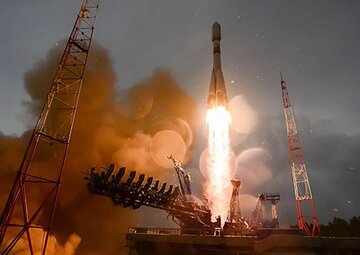
According to Khabaronline, an Iranian news agency, The report notes that Paya, launched into orbit alongside two other Iranian satellites aboard a Soyuz launch vehicle, initially faced a challenge related to its early rotational speed. This issue has now been fully resolved.
With the successful activation of its mirror-based optical cameras, the satellite’s first image has been obtained, indicating that Paya is ahead of its planned schedule and has already entered the sensitive and precise camera calibration phase. The satellite offers imaging resolutions of 10 meters in color and 5 meters in panchromatic (black-and-white) mode.
Regarding the two other satellites, complex control and stabilization processes are proceeding as planned. Precision pointing operations have begun for the “Kosar” satellite, which features a 4-meter imaging resolution, in order to align its camera vertically toward Earth.
All of its subsystems are reported to be performing optimally. Meanwhile, the “Zafar” satellite, with a 15-meter imaging resolution, has successfully completed its de-tumbling phase and is now ready to begin pointing operations. In addition to Earth observation missions, both satellites are also capable of providing Internet of Things (IoT) services.
Looking ahead to future technological development, the Head of the Iranian Space Agency announced the start of the design phase for the “Nahid-3” communications satellite. The project aims to achieve placement in geosynchronous orbit at an altitude of approximately 36,000 kilometers, enabling continuous communications coverage.
Furthermore, launches under the strategic “Martyr Soleimani” satellite constellation project—comprising 24 satellites—are expected to begin by late this year or early next year.
The constellation is designed to reduce data access intervals for crisis management applications to less than one hour. In the field of remote sensing, the “Pars-2” satellite is scheduled for launch in the near future, while the design of next-generation satellites with imaging resolutions of up to one meter is also underway.
These developments represent new steps in the expansion of Iran’s space infrastructure and reflect the country’s growing focus on enhancing Earth observation, communications, and space-based applications at both national and international levels.
Your Comment