
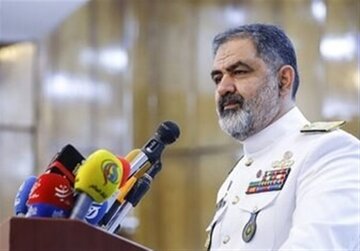
According to Khabaronline, an Iranian news agency, Rear Admiral Shahram Irani, outlining the scope of the exercise, said the BRICS maritime drill will be conducted with the participation of member states including Iran, China, Russia, Brazil, and other partners.
He noted that the main objective of the exercise is to enhance operational cooperation, maritime security, and collective coordination in international waters. South Africa is hosting this year’s edition, and naval units from participating countries are currently en route to the exercise area.
According to the Iranian navy chief, Naval Task Group 103 has been dispatched as part of this plan and is expected to arrive and be stationed in the region within approximately ten days, after which the planned training scenarios will be carried out.
Rear Admiral Irani emphasized the “combined” nature of the exercise, stating that such drills provide an important platform for exchanging experience, improving operational capabilities, and conducting joint naval training on an international scale. He recalled that in recent years Iran, together with China and Russia, has hosted similar exercises in its southern waters, with a strong focus on maritime security, sea-based economy, and the safety of shipping lanes.
He also pointed to the growing number of participating countries, explaining that following trilateral agreements between Iran, Russia, and China, the participation of additional countries has been facilitated. Last year, six countries joined the exercise framework, and this year at least twelve countries are expected to take part, either as active participants or observers—a trend he said reflects the rising international standing and credibility of these drills.
The Iranian navy commander noted that the level of training has also advanced significantly. While earlier exercises were largely limited to search and rescue operations and vessel safety, current drills now include more complex scenarios and what he described as “live” operational training.
Rear Admiral Irani highlighted the creation of a “common operational language” as one of the key achievements of these exercises—an initiative proposed by Iran and formalized in a reference guide shared with participating nations. This framework allows multinational crews to operate together effectively despite differences in native languages, enabling realistic combined operations.
He stressed that the benefits of such maritime exercises extend well beyond the military domain, encompassing diplomatic, economic, and cultural dimensions. According to him, the arrival of naval units in foreign ports sends a clear message of stability, trust, and readiness for broader economic and maritime cooperation.
Rear Admiral Irani also underlined the positive impact on maritime tourism and cultural exchange, noting that exhibitions showcasing Iranian products and culture are often organized in host ports. These activities, he said, help promote indirect dialogue and cooperation in the fields of tourism and the sea-based economy.
In conclusion, the commander stated that combined maritime exercises not only enhance naval capabilities and maritime security but also create a sustainable network of cooperation among friendly nations. This network, he explained, ensures mutual access to ports and facilities when needed and contributes to long-term maritime security in international waters.
Your Comment