
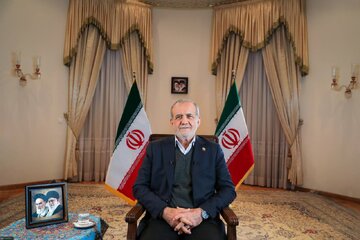
According to Khabaronline, an Iranian news agency, In an in-depth interview with KHAMENEI.IR, the official media outlet of the Office of the Supreme Leader, Pezeshkian outlined the government’s policies in foreign affairs, economic management, and responses to international pressure, stressing that the assumptions of Iran’s adversaries do not reflect the country’s social and political realities.
Pezeshkian said Iran’s relations with neighboring countries have “significantly improved” across cultural, scientific, and economic fields.
He cited expanded cooperation with Azerbaijan, Uzbekistan, Turkmenistan, Afghanistan, Pakistan, Iraq, and Turkey, as well as improved ties with Persian Gulf states including Oman, the United Arab Emirates, and Qatar.
He added that Iran has also established strong relations with China, Russia, Kazakhstan, Kyrgyzstan, and Tajikistan.
The president identified the development of North–South and East–West transit corridors as a top government priority, noting that funding has been allocated and that implementation will accelerate in the coming year.
He said these projects are aimed at strengthening Iran’s geoeconomic position.
Referring to external security assessments, Pezeshkian said some actors believed that a military strike by Israel would lead to the collapse of Iran’s political system.
According to him, these calculations were based on the assumption that such an attack would trigger widespread unrest, disrupt public services, and severely damage livelihoods. “None of this happened,” he said.
Pezeshkian highlighted public reactions during periods of heightened tension, noting that even groups who had previously voiced protests — including some truck drivers — rallied in defense of the country.
He described this response as a clear demonstration of national unity and stressed that policymakers must recognize the value of the people and engage with them respectfully.
The Iranian president described the current situation as a “full-scale war” involving the United States, Israel, and Europe — one that is more complex than the Iran–Iraq War.
He said the pressure is multidimensional, simultaneously targeting Iran’s economy, livelihoods, culture, politics, and security. While Iran’s oil sales, trade, and financial exchanges have been restricted, public expectations have continued to rise, he added.
Pezeshkian pointed to a sharp decline in oil revenues, saying Iran previously sold oil at around $75 per barrel, compared with roughly $50 now. Combined with the economic impact of conflict and sanctions, this has reduced government income. Despite these constraints, he said the government has decided to allocate nearly $2.5 billion to secure essential goods and provide subsidized food assistance to targeted groups ahead of the Persian New Year.
He also referred to his regular meetings with Iran’s Supreme Leader, Ayatollah Ali Khamenei, stating that public livelihoods are the leader’s top concern. Pezeshkian said the government has presented a comprehensive 20-point economic plan focused on controlling inflation, stabilizing the currency, and ensuring access to essential goods and production inputs. The plan, he noted, is being implemented in coordination with the government, parliament, and other institutions and has received the Supreme Leader’s approval.
Addressing security issues, Pezeshkian said Iran’s armed forces, despite ongoing pressures, are now stronger in terms of capabilities and equipment than before. He warned that any further military action against Iran would be met with a “more decisive response.”
In closing, Pezeshkian addressed reports suggesting Iran could collapse within 36 months, noting that earlier predictions had spoken of collapse within days. “If we remain united,” he said, “they will not succeed — not in 36 months, not even in 36,000 years.”
He emphasized that national unity, coordination among state institutions, and public support remain the decisive factors in countering external pressure.
Your Comment