
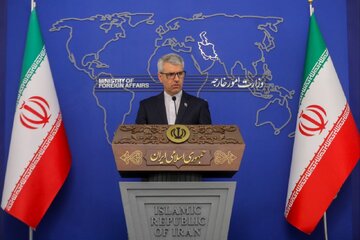
According to Khabaronline, an Iranian news agency, At the start of the briefing, Baqai highlighted the recent summit in Tehran attended by special representatives from neighboring countries of Afghanistan along with Russia. He explained that the purpose of the summit was to discuss the situation in Afghanistan and promote regional consensus. According to him, Iran had invited all relevant parties, including Afghanistan, to participate in the summit. However, the decision not to attend was Afghanistan’s own, and Tehran respects that choice. The spokesperson stressed that given Iran’s long borders with both Afghanistan and Pakistan, the security and stability of the country’s eastern borders is a matter of paramount importance to the Islamic Republic.
He also reaffirmed Iran’s principled stance on Afghanistan, advocating for the resolution of its issues through dialogue and engagement among the various Afghan factions. Tehran supports any process that leads to enhanced understanding, stability, and improved living conditions for the people of Afghanistan.
Diplomatic Activities and Foreign Visits
Baqai announced the continuation of Iran’s active diplomatic efforts, revealing that the Foreign Minister would be traveling to Russia and Belarus in the coming days. He also described the recent visit of the President to Kazakhstan and Turkmenistan as a milestone in Iran’s relations with Central Asia. The visit resulted in the signing of over 20 cooperation agreements, as well as bilateral and multilateral meetings.
Gaza, Lebanon, and Syria: Continued Criticism of Israel's Impunity
The spokesperson described the situation in Gaza as “blatant genocide,” emphasizing that this is not merely Iran’s political stance, but a reality acknowledged by both the International Court of Justice and the International Criminal Court. He attributed the continued support of the U.S. and some Western countries for the Israeli regime as the main factor preventing international bodies from halting these crimes.
Baqai also referred to ongoing violations of Lebanon and Syria's sovereignty, warning that the continued Israeli attacks and foreign presence, including U.S. forces, hinder the return of stability to Syria and foster insecurity and terrorism.
Lebanon and the Appointment of Iran’s Ambassador
Regarding speculation about obstacles in appointing a new Iranian ambassador to Lebanon, Baqai confirmed that diplomatic relations between Tehran and Beirut remain intact. He assured that the process for introducing the ambassador is underway and is expected to proceed normally. Baqai stressed that any statements or actions diverting Lebanon’s attention from the main threat — Israeli aggression — would not serve the country’s interests.
U.S. Interventionism and Historical Responsibility
The Foreign Ministry spokesperson regarded recent statements by U.S. officials about regional interventions as a clear admission of the failure of interventionist policies. He pointed out that the consequences of these policies in Libya, Iraq, and Syria have led to instability, killings, and the rise of terrorism. He added that rather than accepting accountability, the U.S. continues on the same path, with its National Security Strategy prioritizing the maintenance of Israeli dominance in West Asia.
Baqai also emphasized that repetitive claims about human rights violations, supporting terrorism, and destabilization are merely pretexts for exerting pressure on independent countries.
Venezuelan Oil Tanker and Groundless Allegations Against Iran
The spokesperson condemned the seizure of a Venezuelan oil tanker by the U.S., describing it as a clear case of “state piracy” with no legal basis under international law. He also dismissed any attempts to link Iran to developments in Venezuela or Latin America as entirely irrelevant.
Responding to reports about an attack on an Iranian ship, Baqai stated that no information had been received from competent authorities regarding the incident.
Yemen and the Threat of Regional Fragmentation
Baqai assessed recent developments in Yemen and certain foreign actions as part of the Israeli regime’s strategy to divide countries in the region. He stated that any actions contrary to Yemeni-Yemeni dialogue and the preservation of Yemen’s territorial integrity would benefit those opposed to regional security.
Resolution 2231 and Criticism of Europe
He emphasized that Resolution 2231 has expired, noting that the continued reference to it by the UN Secretariat and some members of the Security Council has no legal basis. Baqai considered the actions of the three European countries as politically motivated, asserting that their recent policies have effectively compromised their independence, aligning them with U.S. objectives.
Nuclear File and the International Atomic Energy Agency (IAEA)
The spokesperson confirmed that Iran’s communications with the IAEA continue, but Tehran’s interactions are based on the law passed by the Iranian parliament. Criticizing the repetitive statements of the IAEA’s Director-General, Baqai stressed that such claims do not change the reality and that the Director-General must adopt a technical and impartial approach instead of one-sided views.
The Three Islands: Iran’s Red Line
Baqai firmly rejected the UAE’s claims regarding the three Iranian islands, reiterating that Iran will not tolerate any compromise on its territorial integrity and will not entertain any discussions about the ownership of these islands.
Diplomacy, Deterrence, and Defense Readiness
In response to a question about the future of negotiations with the U.S., Baqai stated that diplomacy is one of Iran’s tools for safeguarding national interests. However, Tehran faces parties that do not value negotiations. He emphasized that Iran’s armed forces are fully prepared to confront any form of adventurism, and this message is crystal clear to opposing parties.
Consular, Sports, and Regional Cases
Baqai announced that the court hearing for Mahdieh Esfandiari would take place in mid-January, expressing hope that this process would lead to her release. He also criticized the U.S. for refusing visas to certain members of Iran’s football delegation, calling it a violation of World Cup host obligations.
Concluding, Baqai referred to the end of UNAMI’s mission in Iraq, stating that Iran respects Baghdad’s decision as a sovereign nation and hopes that this process will contribute to strengthening stability in Iraq and the region.
Your Comment