
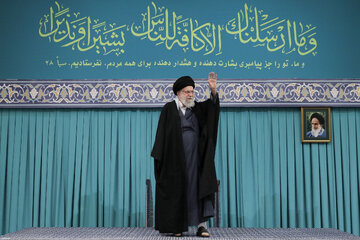
Reyhane Hejazi - In the interview, Trump accused Tehran’s rulers of governing through “repression and violence” and claimed that Ayatollah Ali Khamenei’s leadership had led to the “complete destruction of Iran.”
Even by Trump’s usual standards, these remarks go a step further. This is no longer about policy disagreements. Regime leadership change is framed as a moral necessity, with responsibility for everything placed squarely on one individual.
Trump’s focus on Iran’s Supreme Leader is not accidental. From Washington’s perspective, the Supreme Leader is not merely an official figure; he is the nexus of political power, strategic decision-making, and Iran’s regional influence. Striking at that point means striking at the entire structure.
Earlier statements by Iran’s leader—calling Donald Trump a “criminal” and highlighting the U.S. role in Iran’s recent unrest—partly neutralized the atmosphere of ambiguity and psychological pressure that Trump appeared to be counting on.
This pattern was also evident during Iran’s recent unrest. Trump’s open support for protesters and calls for “regime change” were accompanied by slogans that directly targeted Ayatollah Khamenei personally. The focus was not on reform, but on changing the very top of the power pyramid.
At the same time, Dan Shapiro, former U.S. ambassador to Israel, said he believed Trump would try this very week to have Ayatollah Khamenei assassinated.
Iran’s official response, however, was more measured. Rather than reacting emotionally, President Masoud Pezeshkian tried to clarify the meaning of these threats for audiences outside Iran. Writing on X, he said that any attack on the Supreme Leader of the Islamic Republic would be considered “a full-scale war against the Iranian nation.”
That statement mattered because it was not a personal defense. Pezeshkian tied the issue to national sovereignty. He emphasized that Iran’s economic problems are not solely the result of domestic decisions, but also the product of years of pressure and sanctions that Tehran considers “inhumane.”
The message was clear: personalizing threats will not produce a personal response; the response will be national.
Trump’s remarks also triggered reactions beyond Iran. In Iraq, Hassan al-Abadi of Kataib Sayyid al-Shuhada said the group sees itself as a “human shield” in defense of Iran and its leader. The al-Nujaba movement likewise warned that any threat against Iran’s leader could mark the beginning of a much larger war.
Inside Iran, the same framework was echoed. A spokesman for the armed forces said threats against the Supreme Leader were meaningless and that any concrete action would receive a direct response. Foreign Minister Abbas Araghchi also described these threats as a clear violation of the principles of international law.
Iran’s parliamentary National Security and Foreign Policy Commission went even further, issuing a statement addressed to the U.S. president declaring that any attack on the Supreme Leader would amount to a declaration of war against the entire Islamic world, and that such an act should expect a call for jihad by Islamic scholars and responses from Muslim fighters across the globe.
The intensity of these reactions highlights one key point: for Iran and its allies, the Supreme Leader is not just an individual. He is a symbol of stability and cohesion within the power structure. Threatening him is seen as threatening the entire system.
After the backlash to his threats against Iran’s leader, Trump appears to have pushed forward rather than backed down. In recent interviews with NewsNation, he warned that if Iran were to attempt to assassinate him, the United States would “wipe Iran off the face of the earth.” This tone suggests an effort to shift attention away from pressure on Iran’s leader and toward a personal threat against himself—raising the stakes while once again turning individual figures into the axis of confrontation.
Ultimately, this is where the real danger lies. When politics moves away from structures and becomes centered on individuals, the distance between words and actions shrinks.
The more personal this confrontation becomes, the less room there is for de-escalation, the higher the cost of miscalculation, and the greater the margin for error. Experience shows that in such an environment, a single 0wrong sentence can trigger a sudden and dangerous decision.
Your Comment