
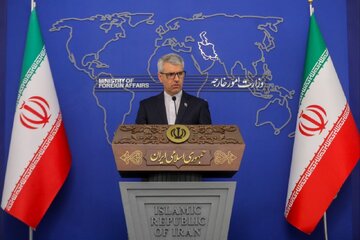
According to Khabaronline, an Iranian news agency, Speaking at a press conference, Baghaei accused Israel of ongoing provocations in the Middle East, saying, “The root of chaos in West Asia, including Syria, Lebanon, Gaza, and beyond, is the Israeli regime.”
He highlighted continuing Israeli attacks against Palestinians despite a formal ceasefire, noting that last night, Israel violated Lebanese airspace 15 times, injuring several Lebanese citizens. Since the ceasefire in Lebanon was established, he said, Israel has committed 6,000 violations, while crimes against Palestinians continue unabated.
Baghaei emphasised that “regional countries are well aware that any insecurity in the region is not only aimed at Iran. Instability is contagious, and therefore it is a shared concern among neighboring states.”
Regarding recent U.S. military movements in the region and joint exercises with Gulf Cooperation Council (GCC) members, the spokesperson said, “The reality is that we are facing a hybrid war.” He added that since a military confrontation in June, Iran has been met almost daily with new threats from the U.S. and Israel.
Reflecting on Iran’s preparedness, Baghaei stated, “Iran is confident in its capabilities. We have past experiences, including the memory of the 12-year war, and we are stronger than ever to respond comprehensively to any aggression.”
Human Rights Council Resolution Sparks Global Division
Baghaei also addressed last week’s UN Human Rights Council resolution against Iran, calling it a source of division in the international community. He criticised Germany and the United Kingdom for presenting “false, exaggerated, and fabricated claims” to push a biased narrative, but noted that 22 council members either voted against, abstained, or did not participate, sending “an important message.”
“We thank those countries that responsibly recognized the reality and did not support this Western-driven resolution,” he added.
Palestinian Rights Must Not Be Compromised
Responding to a question about the so-called Trump Peace Plan, Baghaei stated, “Any plan that undermines or delays the fundamental rights of the Palestinian people is unacceptable and will not succeed.” He described the initiative as a parallel structure to the United Nations that could weaken international institutions and is based on the interests of a single individual or state, making it unsuitable for safeguarding global interests.
Baghaei questioned whether such mechanisms could lead to a new system of guardianship over Palestine and what the implications would be for Palestinian rights. “The right of the Palestinian people, including those in Gaza, should not be treated as a matter of negotiation or commercial interest,” he emphasised.
Iran Condemns U.S. Interference
Baghaei, responding to questions about U.S. threats against Iraq over its cooperation with Iran, as well as reports of Washington pressuring Latin American countries to curb relations with Tehran, said, “These issues demonstrate just how significant Iran is.”
He added, “The Americans claim that Iran is weakened, yet wherever they look, they see Iran’s presence and influence. This, in itself, is a kind of admission of Iran’s stature, while also serving as an excuse to pressure independent nations.”
Baghaei further accused the U.S. of seeking to impose a global dictatorship, asserting, “Their goal is to standardize the world so that no country contradicts U.S. interests.” He reiterated that no sovereign nation, whether in the Middle East or Latin America, would accept such interference if it values its independence and national sovereignty.
U.S. Naval Deployment Will Not Affect Iran’s Resolve
Commenting on the deployment of the aircraft carrier USS Abraham Lincoln to the region and speculation that it may be aimed at preparing for a possible attack on Iran, Baghaei said:
“The presence of a particular warship in the region will not affect Iran’s determination to defend itself and its territorial integrity. We have the will and capability to protect ourselves, and our armed forces carefully monitor every movement, using past experience to strengthen our national security.”
He described U.S. military pressure as a violation of international norms: “Sending forces to the region and issuing threats goes against all principles of the international system. While we know the U.S. pays little heed to these principles, they exist to protect the global community. Ignoring them leads to insecurity for everyone.”
Negotiations Only Possible with Parties Not Seeking War
Responding to questions about U.S. troop deployments and whether the Foreign Ministry has engaged in official or unofficial talks to prevent an attack, Baghaei said, “There is a contradiction in your question. On one hand, you say the other side is preparing for war; on the other, you ask if negotiations are underway to prevent it. One can only negotiate with a party that does not seek war.”
He stressed that Iran has never welcomed conflict and has always engaged in diplomacy, noting, “Even when many believed that negotiations had little chance of success, we held five rounds of talks with the Americans. The side that ultimately sabotaged the talks was the U.S., with the cooperation of the Israeli regime.”
“We Are Honest in Diplomacy and Serious in Defense”
Baghaei reiterated, “We are both sincere in diplomacy and serious in defending ourselves. How can we simply stand by in the face of threats and aggression? Our armed forces confront any attack and respond in a way that will cause regret.”
He added that Iran will continue to perform all its diplomatic duties and engage with countries in the region and beyond. “No responsible nation welcomes war, but if it is imposed, there is no option but to stand firm and defend the country with full capacity,” he said.
No Speculation on Foreign Diplomats’ Intentions
Addressing reports about the British ambassador travelling between Tehran and London, allegedly to create psychological pressure and spread insecurity, Baghaei said, “We do not speculate on the intentions of any ambassador regarding their movements.”
Responding to questions about recent developments in Syria, including U.S. actions involving Kurdish groups, Baghaei said, “The events in Syria are concerning. For us, maintaining Syria’s territorial integrity and unity is essential, and we have repeatedly stated this position.”
Iran Calls for Syria’s Territorial Integrity
He emphasised that respecting Syria’s sovereignty and preventing the country from becoming a breeding ground for terrorism and extremism is critical for regional security. “Protecting Syria from being used to reproduce terrorism and extremism is a necessity that ensures the security of the entire region,” he said.
Baghaei criticised U.S. actions, stating, “American occupation is the main factor behind the resurgence of terrorism in the region. The developments in Syria over the past two weeks are a clear example of the United States’ unreliability and betrayal of its former allies—a lesson showing that relying on external powers brings only instability.”
He also highlighted ongoing regional threats, saying, “What matters most for us is security and stability in West Asia and the Levant. Unfortunately, we continue to witness Israeli aggression against Syria and the persistent U.S. occupation and interference in the country.”
He stressed that lasting stability in the region requires the withdrawal of foreign forces and respect for the sovereignty of independent states.
Iran Says U.S. National Defense Strategy on Iran is Contradictory
Baghaei criticised the United States’ National Defence Strategy for its claims regarding Iran’s nuclear program, calling the document “contradictory” and part of a long-standing effort to promote “Iranophobia.”
Baghaei said that the U.S. strategy should be viewed in the context of decades of American policy toward Iran, which portrays Tehran as a regional problem, despite regional awareness that the main threat in West Asia is Israel.
He noted the contradictions in the strategy, saying, “The document claims that Iran seeks nuclear weapons, yet the U.S. president asserts that American policy has prevented Iran from obtaining them. They accuse Iran of pursuing something that never existed—nuclear weapons are not part of Iran’s defense doctrine, as confirmed by IAEA reports.”
Baghaei also condemned past U.S. and Israeli attacks on Iran’s peaceful nuclear facilities, calling them “illegal actions.”
Commenting on the broader regional focus of the strategy, he added, “The main goal of this document is to ensure the security of the Israeli regime. In pursuit of this objective, the U.S. seeks to sow discord among regional countries. However, given the awareness and understanding in the region, these attempts at destabilization will not succeed.”
Iran Denies Reports About Araghchi's Message to the U.S.
Baghaei strongly rejected claims circulating in some media that Iranian Foreign Minister Abbas Araghchi sent a message to U.S. official Steve Witkoff, accompanied by a written guarantee from Iranian officials, to delay a U.S. attack on Iran.
Addressing the report, Baghaei said, “I have a small complaint about certain media outlets that, without any reflection, publish reports and claims produced by Israeli sources as part of psychological warfare against Iran, and then debate whether the reports are true or false.”
He added, “When the U.S.—a close ally of Israel—acknowledges that information generated by the Israeli regime must be treated with extreme caution, how can some of our media outlets so casually publish and promote these reports?”
Baghaei emphasised, “Absolutely none of the claims in this report about Iran are true. It is a lie and part of the continued disinformation produced by the Israeli regime.”
He noted that the report does underscore one consistent reality: “Israel opposes any diplomacy or engagement. Many false reports and fake news about Iran originate from Israeli sources—for example, the false claim that Iran planned to execute 800 people on January 15.”
Baghaei concluded, “These sources systematically and deliberately inject false information to mislead those who think they influence high-level international decisions, including in the U.S. This is a criminal and dangerous practice that could lead to severe miscalculations.”
Iran Maintains Close Contacts with China and Russia
Responding to a question about defence and military cooperation with Russia and China amid ongoing U.S. threats, Baghaei said, “Our relations with both Russia and China are long-standing, based on mutual respect and interests. Our defense cooperation with both countries has a long history.”
He highlighted major strategic agreements, including Iran’s 25-year comprehensive strategic partnership with China and a comprehensive strategic agreement with Russia that includes defence cooperation. “These partnerships, exchanges, contacts, and consultations will continue robustly,” Baghaei added.
He also noted that China and Russia, as permanent members of the UN Security Council, are concerned with their responsibilities for international peace and security, and Iran remains in close contact with both nations regarding recent developments.
On IAEA Interactions
Addressing comments by IAEA Director General Rafael Grossi about Iran needing to engage with the agency, Baghaei questioned the framing of “non-compliance.” “Which non-compliance? No country has been as committed to its obligations as Iran,” he said, noting that the lack of access to damaged sites stems from prior violations by other parties, not Iran.
Baghaei emphasised that Tehran has always been open to dialogue with the IAEA and that technical discussions fall under the Atomic Energy Organisation of Iran. He criticised the cancellation of a planned meeting with Grossi at the Davos summit, attributing it to pressure from Western countries and “war-mongering” Israeli and U.S. factions.
“It is unacceptable that Switzerland, historically neutral, would cancel hosting Iran’s Foreign Minister under pressure from parties accused of crimes in international courts, merely to prevent Iran’s message from reaching the world,” he said.
Respecting Iraq’s Sovereignty
On the selection of Nouri al-Maliki as Iraq’s next prime minister by the Shia Coordination Framework, Baghaei criticised U.S. attempts to interfere. “Unlike the U.S., we are determined to respect the decision of the Iraqi people. Governance and elections in Iraq are exclusively the prerogative of its people,” he said.
He added, “We must allow the Iraqi people to make decisions about their state institutions and leadership according to their own preferences. U.S. interference in the internal affairs of regional countries has become an ugly habit, and no nation will accept it.”
Diplomacy cannot Be Conducted via Private Texts
Iran’s Foreign Ministry spokesperson, in response to a question about a private text from French President Emmanuel Macron to U.S. President Donald Trump—leaked by Trump online and reportedly suggesting “big actions” against Iran—stated that diplomacy is not conducted through private messages with uncertain confidentiality. Countries must act responsibly in international affairs and not squander their credibility.
The spokesperson called the wording of Macron’s message “ambiguous” and said Iran does not give it much weight. Diplomatically, the sender should clarify their intent. He added that the era of external powers discussing other nations in such a manner is over, noting the humiliating response to the message.
U.S. Human Rights Policy Labelled Hypocritical
Regarding recent unrest in U.S. cities and the dual standards of the White House on human rights, the spokesperson described the U.S. approach as “hypocritical and duplicitous.”
He criticised the international community’s inaction on Israeli actions in Palestine and highlighted how Israeli officials under ICC investigation attend global meetings freely, while Iranian officials face restrictions.
He further noted that the current U.S. administration is more openly self-interested, admitting threats against other nations are for resources rather than hidden under diplomatic language.
He condemned U.S. domestic human rights violations, including police actions against protesters and children, and called U.S. criticism of peaceful protests in Iran part of a long-standing psychological and media campaign.
Iran Rejects EU Parliament Proposal to Label IRGC as Terrorist
On the European Parliament’s attempts to list Iran’s Islamic Revolutionary Guard Corps (IRGC) as a terrorist organisation, the spokesperson said such labelling of a country’s official military is contrary to international law, illogical, and dangerous.
He emphasised the IRGC’s role in combating ISIS and warned that indiscriminate labelling could escalate regional instability. He criticised the U.S. for promoting this approach, with some countries following for the sake of pleasing the U.S. and Israel, urging European nations to resist such pressures.
U.S. Treasury Secretary’s Claims on Iran Denounced
Regarding U.S. Treasury Secretary statements claiming Iran is collapsing under sanctions, the spokesperson called them “admissions of malice.” He said such statements, combined with attacks on Iran’s peaceful nuclear program, reflect U.S. hostility toward the Iranian people and will be documented for potential legal accountability.
Iraq-U.S. ISIS Detainee Transfer
Iran’s Foreign Ministry spokesperson commented on the Iraq-U.S. agreement to transfer ISIS detainees from Syria to Iraq, stating that Iran respects Iraq’s decisions, believing they aim to safeguard national security.
He warned, however, that foreign powers, including the U.S., often impose new security challenges in the region. “The blood of Iranians and Iraqis has been mixed in fighting ISIS. All countries must ensure third-party decisions do not fuel extremism or terrorism,” he said.
Western Double Standards and Greenland Tweet
Regarding a tweet by Iran’s FM Abbas Araghchi about Europe’s treatment similar to Greenland, the spokesperson emphasised Iran’s consistent respect for national sovereignty, criticising Western double standards in international law.
European silence over attacks on Iran’s nuclear facilities has, according to him, encouraged lawlessness and undermined international principles, even threatening Europe itself.
Davos Forum Controversy
At the Davos World Economic Forum, Iran condemned the withdrawal of its Foreign Minister’s invitation while Israeli officials attended, calling it a clear contradiction. He said certain war-promoting parties, including Israel and radical U.S. actors, undermine diplomacy and only seek confrontation.
Iran-Russia Defense Cooperation and Venezuela
Addressing concerns over Iran-Russia defence cooperation following alleged events in Venezuela, the spokesperson called U.S. claims “speculative,” stressing that solutions lie domestically: “The remedy is at home.”
Role of Media in Countering Disinformation
He highlighted the importance of media, domestic and international, in separating truth from falsehood, citing U.S. political actors and Israel as sources of disinformation aimed at influencing U.S. policy and elections.
U.S. Threats to Latin America and Sovereignty
On U.S. threats toward Latin America, especially Cuba, he reiterated that respect for sovereignty and avoidance of force must guide international behaviour. “No country should seek permission from others on how to exercise its sovereignty,” he stated.
Your Comment