

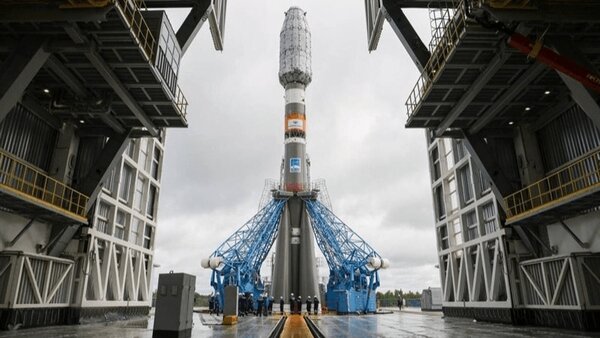
Reyhane Hejazi - Minutes after liftoff, Russia’s state space corporation Roscosmos announced that the Soyuz launch had proceeded “entirely normally and according to plan,” confirming that the satellites would be deployed into their designated orbits based on the predefined schedule.
Roscosmos also confirmed that the mission included a total of 52 satellites, among them the Fregat upper stage and the Aist-1 and Aist-2 Earth-observation satellites, weighing around two tons, designed to generate digital models of the Earth’s surface. Alongside these, 50 additional satellites were placed into orbit, three of which were Iranian.
According to estimates, the Zafar, Paya, and Kowsar satellites will be injected into their respective orbits at 19:07, 19:09, and 19:11 Iran time, respectively.
The first ground communication with these satellites from the Mahdasht ground station is scheduled for 20:00 tonight.

These three satellites are Earth-observation and imaging satellites designed for purposes such as land monitoring, natural resource management, smart agriculture, environmental surveillance, and support for high-level decision-making. Their operational lifetimes are estimated at 2 to 5 years, and the data they transmit to ground stations will enable continuous and precise monitoring of territorial and environmental changes.
The Kowsar satellite was developed by a private knowledge-based company, Zafar-2 is the result of efforts by specialists at Iran University of Science and Technology, and Paya was built by Iran Electronics Industries (SAIRAN). This diversity of developers reflects the emergence of an active, multi-layered ecosystem within Iran’s space sector—one in which universities, the private sector, strategic industries, and government institutions play complementary roles.
From a technical standpoint, Zafar-2 offers imaging resolution of 15 meters, Paya provides 5-meter black-and-white imagery and 10-meter color imagery (upgradable to 5 meters through secondary processing), and the new version of Kowsar delivers 4-meter spatial resolution. Together, these capabilities represent a notable leap in the quality of Iran’s remote-sensing data, significantly enhancing the country’s analytical capacity in areas such as water resources, land subsidence, and environmental risk monitoring.
Speaking at the launch ceremony, Iran’s Minister of Information and Communications Technology described the space industry as “an undeniable necessity for governing and developing the country,” emphasizing its decisive role today in social, economic, and managerial dimensions. He noted that Earth-observation satellites are key tools for land management, with broad applications in water resource management, monitoring water bodies, pollution control, subsidence tracking, and improving agricultural productivity.

He further stressed that the development of high-speed communications infrastructure—especially in rural and hard-to-reach areas—sometimes inevitably requires satellite technologies. According to him, the Iranian government plans to connect all villages with more than 20 households to high-speed communication networks by the end of the Seventh Development Plan.
The selection of the Soyuz launch vehicle for this mission was a technical decision based on international standards. Precise injection of Earth-observation satellites into specific orbits requires narrow launch windows, high accuracy, and operational reliability—criteria that Soyuz, as one of the world’s most reliable launch vehicles with over 1,700 successful missions, meets exceptionally well.
In the global space industry, using foreign launch vehicles for specific missions is common practice. Many countries with advanced space capabilities—including the United States, India, Japan, China, and European nations—utilize international launch services depending on technical, economic, and scheduling considerations.
Experts believe that by pursuing a “hybrid development” model—combining domestic launches with international cooperation—Iran is moving toward increasing the number of missions, reducing launch intervals, and forming satellite constellations. At the same time, domestic infrastructure at various space centers across the country is being expanded and completed to increase the share of indigenous launches in the coming years.
Beyond the analyses, numbers, and technical specifications, what made this launch particularly distinctive for many Iranians was its human and hopeful atmosphere. Images of attendees giving a standing ovation at the launch celebration, precisely at the moment the Soyuz rocket lifted off, quickly went viral on social media.
On social networks, especially Twitter, congratulatory messages poured in one after another: “Congratulations to the Iranian nation.Three indigenous Iranian satellites placed into a 500-kilometer Earth orbit.”
Another user wrote: “If Iran continues on this scientific and collaborative path, a satellite constellation is not out of reach.”
Yet another commented: “Regardless of political views, having three Iranian satellites in Earth orbit at the same time genuinely brings a sense of pride. Science follows its own path.”
The simultaneous launch of three advanced Earth-observation satellites is not only a technical success, but also a clear message of Iran’s determination for an active, sustainable, and purposeful presence in the field of space technologies—one that strengthens data, knowledge, and decision-making power as key components of national development.
Your Comment