
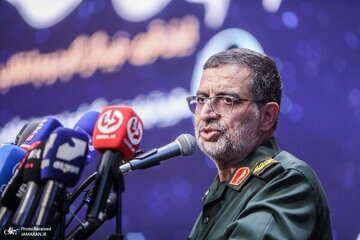
According to KhabarOnline, an Iranian news agency, Brigadier General Ali-Mohammad Naeini emphasized that the 12-day conflict demonstrated the centrality of science and technology in modern warfare, noting that contemporary conflicts are hybrid, technological, and asymmetric by nature.
The IRGC spokesperson and Deputy for Public Relations underscored that military effectiveness today requires more than merely launching missiles or drones; such systems must be technologically advanced and integrated with electronic, cyber, and technical warfare capabilities—an area in which universities and scientific institutions play a critical, decisive role.
He added that military analysts assess modern conflicts by examining their political objectives. He stated that during the 12-day conflict, the adversary’s political goals were regime change, nuclear destruction, elimination of scientists and military personnel, and dismantling Iran’s pillars of power and knowledge—objectives in which, according to him, Israel failed. Naeini cited comments from Benjamin Netanyahu and Donald Trump declaring on the fifth day of the war that they sought to "finish" Iran.
Naeini said the enemy’s operational plan relied on high-intensity, surprise airstrikes aimed at dragging the war into Iranian territory by targeting Iran’s scientific, military, and defense components. He asserted that the ultimate objective included provoking domestic unrest, military revolt, armed incursions from the borders, and fragmentation of the country.
He argued that, based on globally accepted criteria used in war studies, the side that fails to achieve its political, civilizational, and narrative goals is the one that suffers strategic defeat.
Naeini described the first day of the 12-day war as pivotal. He said Iran’s armed forces immediately restored command cycles, replaced affected commanders, and launched Operation True Promise-3 within hours—an operation he described as innovative, hybrid, and grounded in electronic, cyber, missile, and drone warfare with comprehensive intelligence coverage. He reiterated that Israel’s strike on an Iranian fuel depot was met within hours by Iran’s two-wave attack on the Haifa refinery, and that the strike on an Iranian intelligence center was answered with an attack on the Mossad facility that resulted in 36 fatalities.
The IRGC spokesperson said Israeli military and security casualties were “certainly higher” than Iran’s, adding that damage inflicted inside Israel’s small geographic area was significantly more extensive. He highlighted the precision of Iran’s aerospace operations, including a strike on the underground floor of a 32-story building that housed Israel’s stock-exchange data center—an outcome he described as evidence of Iran’s high targeting accuracy. He also characterized Iran’s missile destructive power as significant.
According to Naeini, Israel had full access to global technologies and missile-defense systems, supplemented by the United States—the world’s most powerful military, equipped with nuclear submarines and the largest stockpile of nuclear warheads. He argued that in effect, “a nuclear army was facing Iran,” yet Iran relied solely on its domestic defense-industrial capabilities and popular support.
He added that each Iranian missile had to pass through multiple layers of interception, including radar networks, air bases, and 200–250 fighter aircraft across Iraq, Jordan, Syria, and the occupied territories, which functioned as a unified defensive grid. Naeini argued that despite this, Iranian missiles penetrated successfully, including a single missile that reportedly caused damage “multiple times greater” than expected.
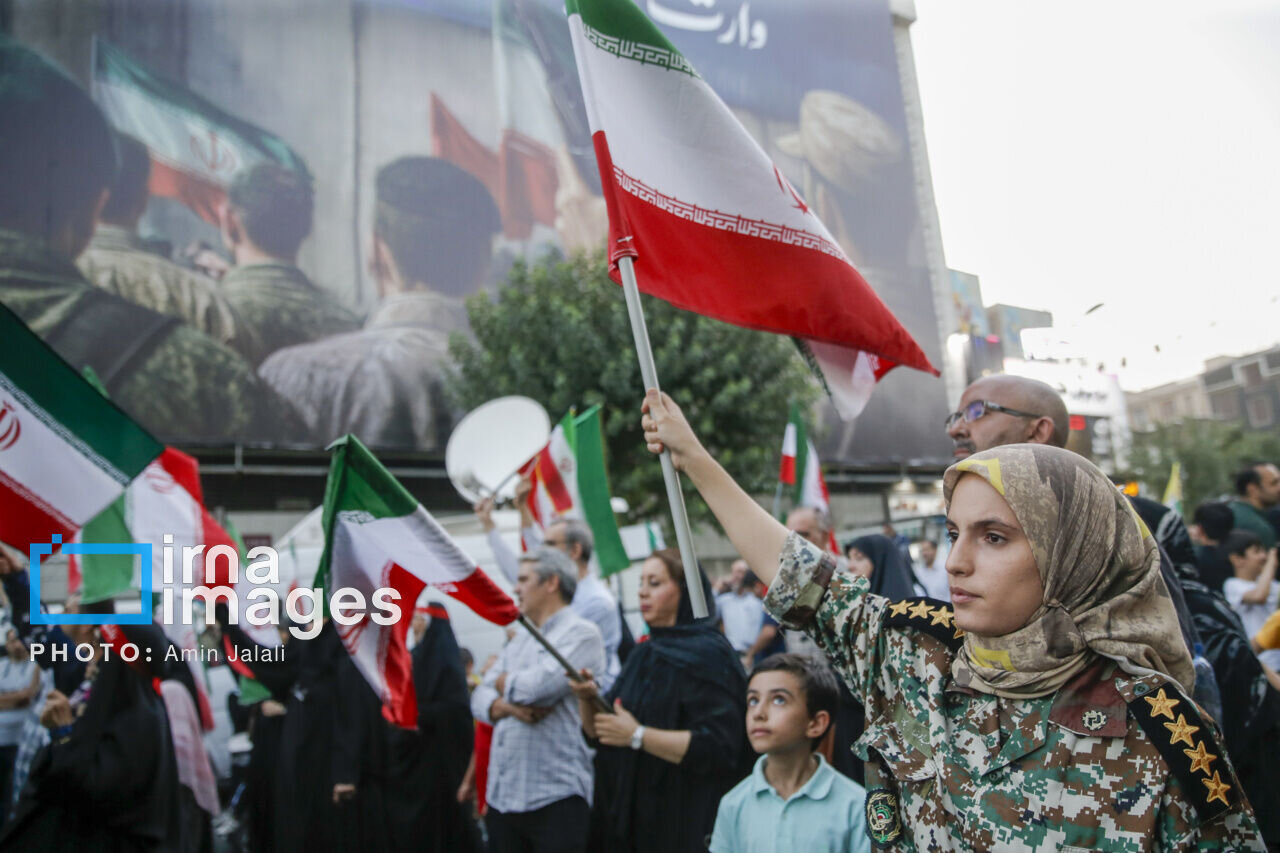
He stated that strategic research centers abroad have acknowledged that even a surprise offensive with full intelligence coverage can succeed only if the targeted side fails to recover quickly. He said Israel was caught off-guard by Iran’s rapid command restoration and its 22 continuous waves of retaliatory missile fire, which he called the defining feature of True Promise-3. Naeini added that U.S. think tanks now categorize contemporary strategic eras into “before” and “after” the 12-day war. He described the conflict as unprecedented, with extensive potential for future documentation and analysis, and argued that Iran succeeded in projecting deterrent power and achieving what he described as a clear sense of victory among the Iranian public.
He said global, regional, and domestic surveys indicate a strong sense of victory among Iranians, with some polls showing as high as 80 percent. By contrast, he said only 13 percent of the population in the occupied territories considers Israel to have met its objectives. He described internal coherence in Iran during the conflict as “extraordinary,” citing seamless coordination between the government and military and Iran’s complete prevention of terrorist incidents throughout the 12 days. According to him, Israel repeatedly sought to end the war through indirect messages as Iran maintained operational initiative.
Addressing questions on why Iran did not seek military assistance from China and Russia, Naeini said military intervention requires formal treaties, and Iran has no such agreements with Beijing or Moscow. Iran, he stated, did not request military aid. Instead, Iran’s strategy was to counter the “weak Iran” narrative by demonstrating its independent capability to confront even the entire NATO bloc. China and Russia, he said, provided political and intelligence support—but not military involvement.
Responding to questions about air-defense failures, he noted that no major military power can claim complete invulnerability. He recalled Iran’s strike on the U.S. Al-Udeid Air Base in Qatar with 14 missiles, of which six hit their targets, and said the United States later acknowledged that intercepting them cost $111 million. He argued that air-defense vulnerability is universal and relative.
On the issue of accepting a ceasefire, he said Iran had not sought war and was not the initiator. He cited Iran’s strategy—set by the Supreme Leader—that war must be prevented and, if it occurs, contained swiftly. He argued that once Israel failed to achieve its strategic objectives and began requesting cessation of hostilities, accepting a ceasefire was a rational, high-level policy consistent with the logic that had previously governed Iran’s acceptance of UN Resolution 598.
Addressing claims of widespread espionage and infiltration, Naeini said such narratives were largely produced by Israel to inflate its image of intelligence superiority. He maintained that portraying Mossad as omnipresent was part of Israel’s psychological-warfare strategy. According to him, Israel’s intelligence capabilities rely heavily on technological tools such as spy satellites, drones, cyber intrusions, data harvesting, and AI-assisted analysis—not primarily on human agents.
He added that Iran, too, has human-intelligence penetration inside Israel, citing 60 active cases involving alleged infiltrators in the occupied territories who, he said, have been prosecuted. He added that during the 12-day war, Iran’s intelligence bodies arrested several networks inside Iran as well.
Naeini concluded by arguing that intelligence warfare is reciprocal and that both sides operate human and technological espionage systems. He emphasized that much of Iran’s cyber activity—including Iran’s reported handling of over 400–500 cyberattacks—remains classified.
Your Comment